
Journal Safari: AlphaGenome Knows Which Way, Not How Much
Published on • 9 min read
Going into this one I had high hopes, and AlphaFold is why. AlphaFold2 is my bar for a DeepMind biology paper. Demis Hassabis and John Jumper shared half of the 2024 Nobel Prize in Chemistry for it, and the Nobel announcement says it “has been used by more than two million people from 190 countries.” So when AlphaGenome came out of the same lab in Nature in January (open access), I filed it under “probably the next one.”
It isn’t, and one of the paper’s own referees said so first. From the public peer-review file: “Given the rather incremental improvement of the individual prediction tasks, AlphaGenome will likely not be the AlphaFold for genomics.”
Two confessions: I’m getting a little jaded on big splashy papers, and I didn’t spend as long with this one as I usually do. So this installment is a vibe check and a few takeaways, not a figure-by-figure walk.
Why This Paper
Two earlier installments ended up in the same place. The UK Biobank’s whole-genome paper found that for protein-coding genes, genomes mostly tie exomes, and that the real gains sit outside the coding genome. And the last one had more than 700,000 genomes and still read them as exomes. Both point at the non-coding genome, which is the hard part to read. The paper’s own number: “more than 98% of observed genetic variation in humans is non-coding.”
What They Did
A “track” is one experiment laid along the genome: a value at every base for RNA-seq coverage, or chromatin accessibility, or one histone mark in one cell type. Sequence-to-function models learn to predict tracks from DNA alone. To score a variant, predict with and without it and take the difference.
The paper’s pitch is breaking two trade-offs. Base-pair models like SpliceAI see “10 kb or less” of sequence. Long-context models like Enformer and Borzoi see “approximately 200–500 kb” but output 32- or 128-bp bins, which “can blur” splice sites and transcription-factor footprints. And specialists own one modality each, while generalists “can lag behind” them on splicing. AlphaGenome reads 1 Mb and predicts 5,930 human or 1,128 mouse tracks across 11 output types, from expression and splicing to histone marks and 3D contact maps. The expression, accessibility and splicing outputs are at single-base resolution.
Training happens twice. A set of full models learns from real data, then a single “student” learns to reproduce their predictions on randomly mutated inputs, so it gets practice on sequences that aren’t in the reference genome. That’s what a variant is. It’s a cousin of the many-models-teach-one trick in VESM. Scoring a variant across every track takes “less than 1 s on an NVIDIA H100 GPU.”
A Little Better at Everything
The headline is that AlphaGenome “matches or exceeds the strongest available external models in 25 of 26 evaluations of variant effect prediction.” That’s a demanding design, because every row has its own champion, from Pangolin on splicing to Borzoi on expression. But the bars are relative improvements, and many are small. On deep-intronic and synonymous ClinVar variants, scored for splicing, it’s an auPRC of 0.66 against Pangolin’s 0.64.
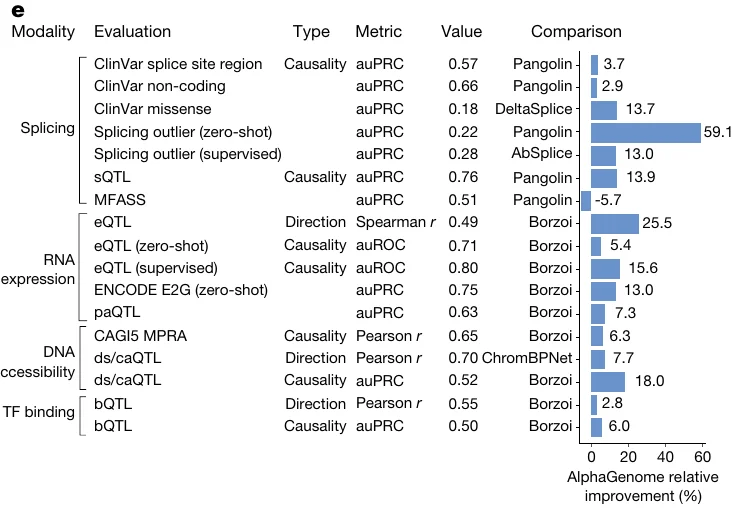
The biggest margins are for rare variants behind splicing outliers in GTEx (+59% over Pangolin, auPRC 0.22 against 0.14) and for eQTL effects (+25.5% over Borzoi). Most of the rest sit in the single digits or teens.
The referees read it the way I did. Referee #2: “the improvements are modest, but it nevertheless remains an impressive advance.” Referee #3: “it is largely the scope and comprehensiveness of AlphaGenome that stands out.” That scope is the part I find genuinely cool. No single row would make me switch tools, but one model that tells you, for any variant, whether it touches splicing, accessibility, a histone mark or expression, in which tissues, and which way, is a first look at mechanism, not a better score. Its showcase, leukemia mutations near the TAL1 oncogene, “accurately recapitulates the mechanisms” already worked out in the lab.
Which Way, Not How Much
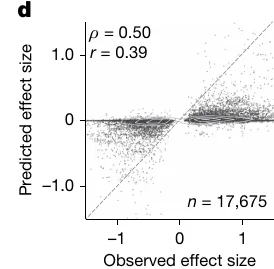
Across 17,675 fine-mapped GTEx eQTLs, the Spearman correlation between predicted and observed effect is 0.50. Most of that comes from getting the sign right. Take absolute values, so the question becomes “is this a big eQTL or a small one?”, and it drops to 0.10. AlphaGenome knows which way a variant pushes a gene. It barely knows how hard, except when it’s confident: for its top calls, above the 99th percentile of scores, the paper reports a correlation of 0.73.
An outside group got there from another angle. Drusinsky and Pollard (bioRxiv preprint) found that AlphaGenome “pervasively underestimates the effects of most causal variants and fails to successfully fine-map eQTLs in most loci.” Their other finding is the useful one: the very strongest predictions are “strongly enriched for causal variants with directionally correct predictions.”
The paper is candid about the rest of the edges. Regulatory elements more than 100 kb away remain “a continuing objective.” Personal-genome prediction is “a known weakness of models in this space” that they have “not yet benchmarked.” And for Mendelian variants, the Supplementary Information says “CADD strongly outperforms all other methods,” likely because conservation helps it “separate rare from common variants.”
I’d use it as a scanner, which is roughly how the Discussion pitches it too: “prioritization of resource-intensive wet-lab experiments.” Point it at a locus or a GWAS credible set, see which modality lights up and which way, then measure with something built for that question: an eQTL pipeline for effect size, a minigene assay for a splicing call, conservation for whether the position matters at all. A quiet result doesn’t clear a variant, though. Maybe that’s where biology is: too big and too varied for one general model to be light-years ahead of every specialist, so the generalist triages and the specialists measure.
Hunches, Then the Wet Lab
AlphaFold and Google’s earlier genomics hit, DeepVariant, each took on one well-posed problem with a fixed answer key. AlphaFold’s was protein structure, judged at the CASP14 prediction assessment. DeepVariant’s was variant calling, trained against “true genotype calls.” AlphaGenome’s answer key is thousands of experimental tracks, each one assay in one cell type.
It reminds me of frontier language models. In my use, ask one about a specialized problem and it usually points the right way; ask how big the effect is and it gets vague, or confidently wrong. Good hunches, like a well-trained scientist’s. Pinning down the size still takes a person who keeps turning the problem over and restating it until it gives. It’s the same split I set up with my preprint-ranking intern: it points, I read. An agent that calls AlphaGenome as one tool and a specialist as the next doesn’t feel far off.
What does feel far off is the wet lab, usually the last step in biology, and Referee #3’s other complaint was that “no experiments were performed to validate any novel hypotheses.” A Brigham and Women’s group outside DeepMind (bioRxiv preprint) used AlphaGenome to prioritize non-coding variants in the RHD blood-group gene, base-edited them in K562 cells, and checked expression by qPCR and flow cytometry. By their account it’s “the first validation of AlphaGenome predictions at the phenotypic level using wet-lab experiments.” The model was the fast part.
The dream is a frontier model that runs the analysis and hands the plate to its robot partner. Companies are working on it. Lila says its AI and “autonomous labs” generate hypotheses and design and run experiments. Transfyr is coming from the other end, using sensors and multimodal models to record the physical work of scientists, including the “hidden tacit knowledge” in a protocol. Closed loops already exist for simpler problems. A robot scientist named Adam tested its own yeast gene-function hypotheses in 2009, and GPT-5 recently ran cell-free protein experiments on Ginkgo’s cloud lab, with people mostly loading reagents. I think the harder version, from a variant prediction to an edited human cell and a measured phenotype with no person in the middle, is still 10 to 15 years out.
What I’d Push On
Nothing new was tested. The TAL1 case recovers a known mechanism. Its one new lead, a second ETS-like motif whose role the authors call “currently unknown,” was never checked in a lab.
Open, with an asterisk. The SDK and model code are open source (Apache 2.0), but the API and the weights are for non-commercial use. Outputs “should not be used for the training of other machine learning models” and “must not be used for clinical decision-making.” Commercial access goes through Google Cloud.
The Data-Infrastructure Coda
As of mid-October, OpenAlex counts 356 works citing the paper or its 2025 preprint, and Europe PMC finds 49 papers that name AlphaGenome in their Methods. The integration I’d point to is a file. Ensembl’s Variant Effect Predictor now has a plugin that reads a precomputed, tabix-indexed file of AlphaGenome Variant Impact scores (which also fold in AlphaMissense) for single-nucleotide variants, “available for commercial and non-commercial use.” For variant interpretation, the model is the factory and the score table is the product.
The SDK hands back variant scores as AnnData objects, one per scorer, with scores in X and track metadata in var, and its own tidy_scores() flattens them into a long table. I do data infrastructure for a living, and TileDB-SOMA is part of my day job, so treat this as an interested party’s reading. SOMA already speaks AnnData: from_anndata ingests one, and after register_anndatas maps the new rows, appends more to the same experiment. Whether that beats the long table for a whole cohort is something I’d measure before I’d claim it.
Star rating: three out of five. It’s the most useful multimodal readout I’ve seen and honest about its limits in the Discussion, but its scorecard counts wins, not margins.
Related Posts
Journal Safari: Ask Eleven Models, Keep the Worst Answer
Journal Safari #4. Eleven ESM protein language models were supposed to be near-interchangeable. They have different blind spots that do not overlap, and training each one on the others' best guesses puts sequence-only at the top of the ClinVar board. The gain comes off about 200 proteins, which is the part I keep chewing on.
Journal Safari: Seven Million Parameters and a MacBook Air
Journal Safari #3. Pan-human Azimuth puts 27 million cells from 23 tissues on one annotation tree, then classifies them with a model 70× smaller than the foundation model I read in July — and wins. The contribution is not the model. It is the labels.
Journal Safari: Can You Compress a Cell Into a Word?
Kicking off Journal Safari, my biweekly close-read of one recent paper. First up: CellVQ, a 500-million-parameter single-cell foundation model that squashes every cell into a discrete code — and the peer reviews that quietly agreed with my doubts.