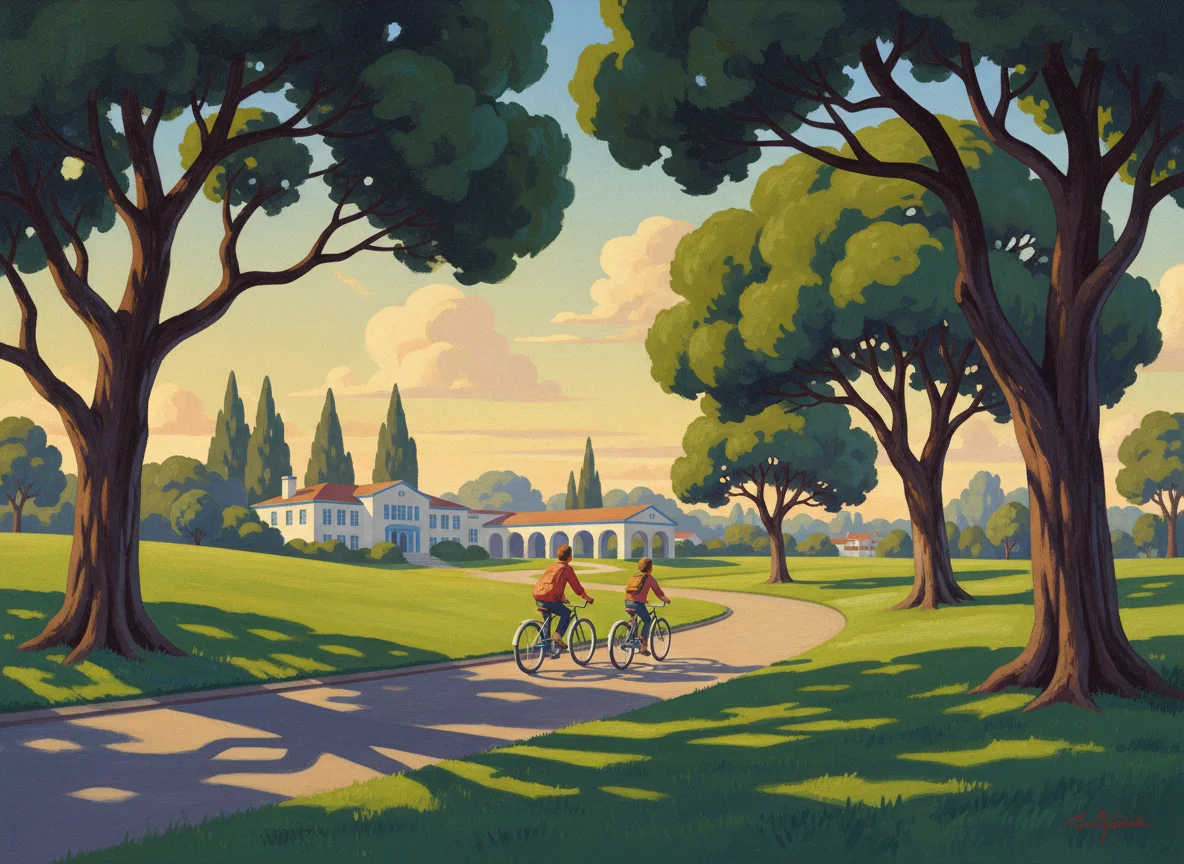
School Gets Out at 12:05 on Thursdays
Published on • 14 min read
Also on Apple Podcasts and Amazon Music.
My daughter starts transitional kindergarten this fall. She’s almost four and, thanks to California, her school is free.
That last part deserves a moment of silence, because for the past few years we’ve been paying somewhere between $15,000 and $30,000 a year for childcare (which, if you don’t have kids, is not a typo). It’s roughly what San Diego families actually pay: the YMCA’s Childcare Resource Service puts the county average around $15,000 a year for a preschooler, and the fancy ZIP codes run north of $600 a week. California’s universal TK expansion, passed in 2021 and fully phased in as of last school year, means every four-year-old in the state now gets a free public classroom. That’s a $2.7-billion-a-year commitment. It is, genuinely, one of the best things this state has done for young families.
Then I looked at the bell schedule.
School starts at 8:10 AM. It ends at 2:20 PM. Except on Thursdays, when it ends at 12:05 PM 😲.
Twelve. Oh-five. On a weekday. A day when, per long-standing American custom, both parents are expected to be at work being productive members of the economy until at least 5:00.
So this post is me doing what I always do when something confuses me: going and finding the data. How did the American school day get this short? Who decided this? And how is everyone else, here and abroad, actually surviving it?
Let’s Do the Math
Start with the arithmetic, because it’s genuinely bonkers.
A standard American school year is about 180 days at roughly 6.5 hours a day. That’s about 1,170 hours of school a year. A full-time job (the Dolly Parton special, 9 to 5, fifty weeks a year) is about 2,000 hours. That’s a gap of more than 800 hours a year that somebody has to cover, and that’s before anyone commutes anywhere. (That math is mine; nobody publishes an official “gap” number, which is itself telling.)

The Center for American Progress actually titled their report on this “Workin’ 9 to 5”, so at least the wonks share my soundtrack. Their findings, from analyzing the calendars of districts serving six million students:
- Schools are closed 29 days per school year, not counting summer. The average private-sector worker gets 16 days of paid vacation and holidays. The school calendar takes two more workweeks off than you do.
- The median school day ends at 2:50 PM, and virtually every district in the country is closed by 3:30.
- Only about 45% of public elementary schools offer both before- and after-school care.
- Families who patch the gap with paid care spend about $6,600 a year doing it.
- The misalignment costs the US economy an estimated $55 billion annually in lost productivity.
We lucked into a spot in our school’s extended-care program, run through the local YMCA, and I’m grateful for it. But “lucked into” is doing a lot of work in that sentence. A schedule that only functions if you win a wraparound-care lottery is not a system. It’s a bake sale with enrollment caps.
Blame Cities, Not Farms
Here’s where the research surprised me. I assumed, like most people, that the short school day and long summer were agrarian leftovers. Kids needed to bring in the harvest, right?
Wrong. Historian Kenneth Gold, who wrote an entire book on this, calls the farm story a myth. Farm kids were needed in spring (planting) and fall (harvest). Rural schools historically ran short winter and summer terms so kids could work during the shoulder seasons. Summer was actually when farm kids went to school.
The long summer break was invented in cities. Urban schools in the mid-1800s ran nearly year-round: New York City schools were open about 248 days in 1842. But attendance was voluntary, summer attendance collapsed in sweltering pre-air-conditioning brick buildings, wealthy families decamped for cooler climates, and late-19th-century reformers eventually standardized everyone onto one compromise calendar with summers off. Gold’s framing is that the school calendar was “a conscious creation” — just not one that had anything to do with corn.
And the amount of schooling used to be far lower: in 1890 the average American kid attended about 86 days of school a year. Compulsory-attendance and child-labor laws ratcheted that upward until 180 days hardened into the norm by the early 20th century (New York’s requirement hit 180 days by 1921), and it has barely moved in a hundred years.
The 6.5-hour day? I looked hard for the origin story, and here’s the honest answer: there isn’t one. No commission, no landmark law, no famous report. The best historians can offer is that it congealed out of industrial-era standardization and then survived on pure inertia. The single most important number in every working parent’s life, and nobody decided it. It’s just… always been there, like the QWERTY keyboard or the penny. Then again, we finally retired the penny last November, after 232 years. Turns out century-old defaults can die. Somebody just has to call the question.
The state-level patchwork backs this up. Pew’s analysis found required days range from 160 (Colorado) to 186 (Kansas), and required daily hours for an 8th grader range from three hours in Maryland and Missouri to 6.5 in Tennessee. Kindergarten is wilder still: only 16 states plus DC even require districts to offer full-day kindergarten. This isn’t a designed system with regional variants. It’s fifty separate accidents.
As for our beloved 12:05 Thursday: that’s a “minimum day,” and it exists to give teachers common planning and professional-development time. Which teachers absolutely need and deserve. They’re contracted for fixed hours, so the student day gets shaved to create adult collaboration time. The kicker is that nobody even tracks how widespread this is. Education researcher Anna Egalite calls it “the quiet erosion of the five-day school week”: early dismissals, in-term teacher workdays, and partial days that show up in no national dataset. The five-day, full-day school week is dissolving and we’re not even measuring the rate.
The Two-Income Trap Called It
A couple of years ago I read The Two-Income Trap, which Elizabeth Warren wrote with her daughter Amelia Warren Tyagi back in 2003, and this whole bell-schedule saga keeps dragging me back to it.
The book’s core claim: the early-1970s median family ran on one income, and by the early 2000s the typical family with kids ran on two, yet all that extra income got bid straight into fixed costs (a mortgage near good schools, a second car, health insurance, childcare), leaving families with less slack, not more. I went and checked the underlying numbers, and the trends are real:
- In 1970, 45.7% of married-couple families had both spouses employed. By 2000 it was 53.2%, a majority. Today, among married couples with kids, it’s 66.3%.
- Labor force participation for mothers with children under six went from 39% in 1975 to 65% by 2000.
- The personal saving rate averaged around 12% in the 1970s and around 4% in the 2000s, bottoming near 1.4% in 2005.
(Fairness note, because I’m a data guy before I’m a partisan: the book’s exact discretionary-income table has been contested on inflation-index grounds, from critics on both the left and the right. But the direction of every trend — two earners now required, savings gone, fixed costs devouring the second paycheck — holds up fine in the federal data.)
Here’s the part that gets me. The school schedule was fossilized by 1921, when one parent was home at 2:20 by default. The economy then spent five decades quietly repricing the middle class around two incomes, while the bell schedule didn’t move an inch. We rebuilt the entire household economy and forgot to tell the schools. If you want the white picket fence, the kids, and the bootstraps, the current design requires either a stay-at-home parent (which the mortgage now forbids), a grandparent on retainer, or a YMCA program with a waitlist.
How Does Everyone Else Do It?
My first hypothesis was that top-performing countries just run longer school days. The data laughed at me.
American kids get more instructional time than almost everyone. US primary schoolers receive about 974 hours a year against an OECD average of 804, sixth-longest among 42 systems tracked. Finland, the perennial education darling, clocks in around 660 hours. Japan and Korea are below the OECD average too. (A word on where the US actually stands, because I checked: on PISA 2022 we’re above the OECD average in reading and science, and 26th in math. Some will call that reassuring. I’d point out that “above average” is a strange victory lap for a self-declared exceptional nation. The world’s wavering superpower is out here celebrating a participation trophy. Singapore scored 575 in math. We scored 465. By the standard America sets for itself, that is falling behind.)
So the American problem isn’t the number of school hours. It’s what happens at 2:20. The countries that make this work don’t run longer schools. They wrap care around the school day and treat it as public infrastructure:
- Sweden runs fritids (i.e., after-school centers physically inside the school), attended by more than 80% of six-year-olds, with fees capped nationally on an income-linked sliding scale.
- Denmark guarantees every child in the early grades a place in after-school care (SFO). Guaranteed. As in, a legal entitlement.
- Germany goes live with a statutory right to eight hours of all-day care, five days a week, for every first-grader starting August 1, 2026 (next month, as I write this), expanding one grade per year.
- France gives primary kids Wednesdays off (yes, really), but every commune runs cheap subsidized périscolaire before- and after-school care, often until 6 PM, with homework help.
- South Korea is the cautionary tale: the gap gets bridged privately, through the hagwon cram-school industry, on which Korean families spent a record $20.6 billion in 2023; 86% of elementary students participate. That’s what “let the market handle it” looks like at scale.
The underlying budget choice is stark: the US spends less than 0.5% of GDP on early childhood education and care, near the bottom of the OECD. The Nordics spend roughly three times that. Sweden’s fritids worker and my daughter’s YMCA staffer do the same job: one is public infrastructure, the other is a lifeboat you have to win a seat on.
A Quick Word About “Choice”
I can hear the rebuttal already: this is why we need school choice. Since my neighbors are increasingly skittish about public schools (and public confidence has fallen to 28%, with enrollment down more than a million students since 2019), it’s worth a short detour. I’ll try to be fair, but I won’t pretend to be neutral.
Follow the money in the new universal voucher states. In Florida’s expanded program, 69% of new voucher recipients were already in private school. In Arizona, estimates run 75–82%, and recipients cluster in ZIP codes with median incomes of $81K–$178K, with about 5% from the poorest ZIPs. These programs aren’t primarily rescuing kids from failing schools. They’re back-paying tuition for families who had already left, at a cost of hundreds of millions per state per year. Meanwhile every departing student takes per-pupil funding with them while the district’s fixed costs stay put, an effect estimated at $65 million a year for San Diego Unified alone. And the academic evidence? The most rigorous voucher studies (a randomized lottery in Louisiana, longitudinal work in Indiana and Ohio) found significant, persistent negative effects on math achievement. (Honesty compels: charter results are more mixed and modestly positive in recent studies, and some voucher studies find graduation-rate gains even where test scores drop. The literature is messier than either side’s bumper sticker.)
On safety — the fear I hear most from other parents — the data is almost a relief. School-associated homicides are a vanishingly small share of youth homicides, around 1% in most years. Statistically, school remains one of the safest places a child spends time, and private schools are no force field; the 2023 Covenant School shooting was at a private Christian academy. The grim actuarial truth is that most child firearm deaths happen at home, not at school. If you’re optimizing for your kid’s safety, a gun safe does more than a tuition check.
I went to public school in Oklahoma. Pre-AP classes from middle school on, AP everything in high school, and by senior year I was taking college courses at the local junior college — for free. That pipeline existed because everyone’s kids were in the same pool, so everyone had a stake in the pool being good. Fragment the funding, and you don’t get a thousand flourishing options. You get stratification with extra paperwork.
The Part Where I Stop Complaining
But what I keep coming back to, schedule grumbling aside, is that I’m excited.
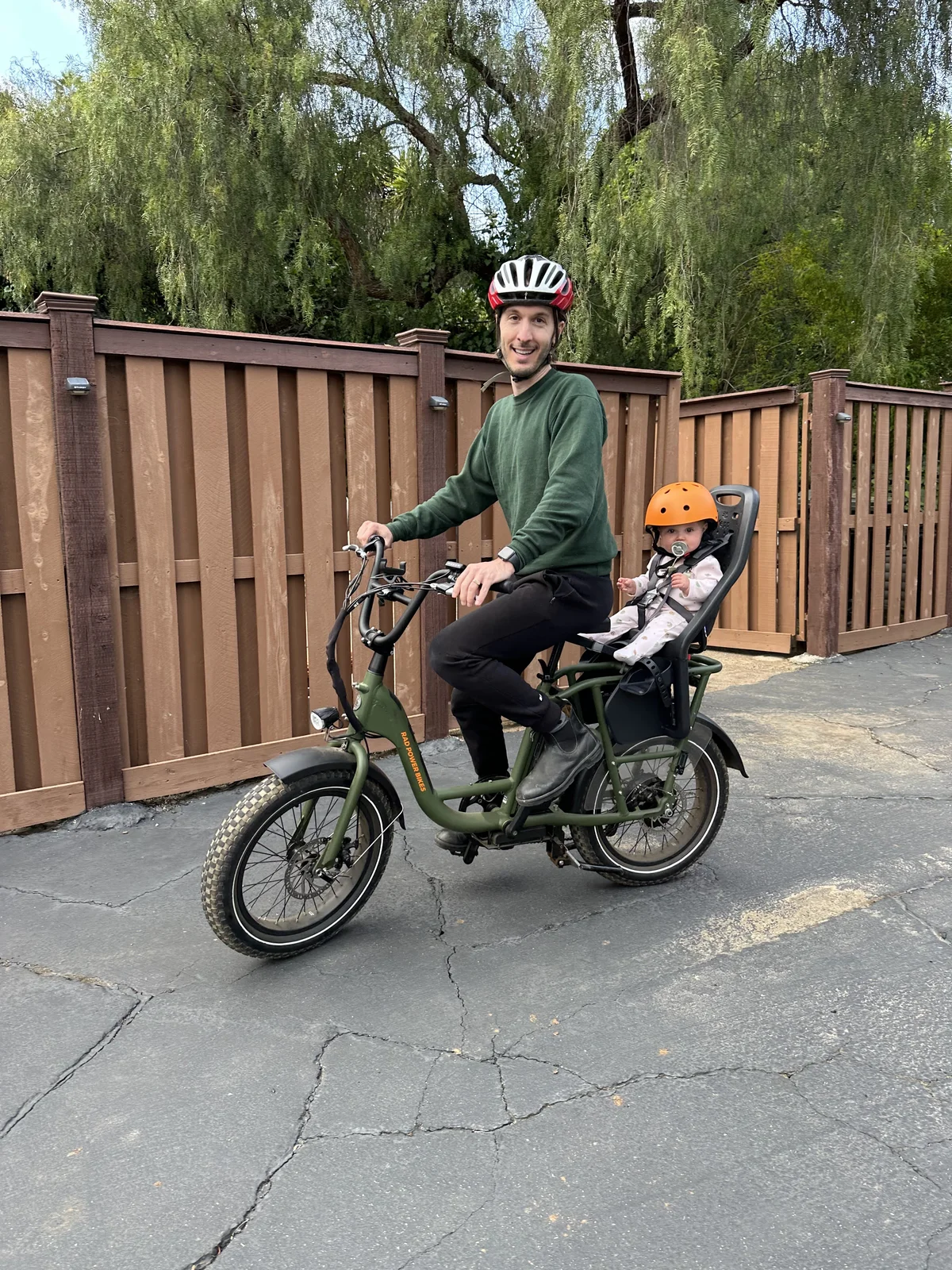
Because her school is close enough that we get to ride bikes there. Every day. Through a city park, no less — a proper one, with grass and old trees and a playground she has already personally quality-tested. Morning bike commute with my kid through a park: there are venture-funded startups promising less happiness than that.
Growing up in Oklahoma, school architecture had one job: keep the weather out. Passing periods happened indoors because outside was either 105°F, sleeting sideways, or actively rotating. My daughter’s school, meanwhile, has an open-air arcade: white stucco, blue trim, covered walkways open to the sky, kids flowing between classrooms and lunch tables entirely outdoors. The first time I saw it I half expected the T-Birds to slide across a lunch table mid-song. It’s the California of postcards, and a four-year-old gets to just… go to school there.
More cities should be built this way: schools next to parks, kids on bikes, buildings that assume the outdoors is a feature rather than a threat. And more school systems should be built the way California is finally, slowly starting to: as if families actually exist. Universal TK is a genuinely big deal: free school for every four-year-old in the most populous state in the country. Germany just wrote all-day care into law. It’s possible. It’s even affordable, for less than we lose in productivity to the current mess.
Now somebody just needs to tell the bell schedule that Rosie the Riveter won, Dolly was right, and nobody’s been home at 12:05 on a Thursday since 1974.
We’ll be the ones on the bikes.
Reference Links
California Universal TK:
- PPIC: California’s Transitional Kindergarten expansion
- LAO: The 2025-26 Budget — Transitional Kindergarten
- KQED: California’s $2.7 billion TK plan
- Axios San Diego: What childcare costs in San Diego
The School/Work Schedule Gap:
- Center for American Progress: Workin’ 9 to 5 (2016)
- Pew Research: 180 days is common, but day length varies wildly
- ECS: 50-state comparison of instructional time policies
- Education Next: The quiet erosion of the five-day school week
History of the School Calendar:
- PBS NewsHour: Debunking the myth of summer vacation (Kenneth Gold)
- Education Reimagined: Why 180 days?
The Two-Income Trap:
- Warren & Tyagi, The Two-Income Trap (2003)
- BLS: Employment characteristics of families, 2024
- DOL: Labor force participation of mothers by age of youngest child
- FRED: Personal saving rate
- People’s Policy Project: critique of the book’s inflation math
International Comparisons:
- OECD Education GPS: US instructional time profile
- OECD: Finland country note, Education at a Glance 2025
- NCES: PISA 2022 US results
- German federal government: legal right to all-day primary care from Aug 2026
- Korea Times: private education spending hits record high
- OECD Family Database: public spending on childcare and early education (PF3.1)
School Choice and Safety:
- Florida Policy Institute: voucher expansion analysis
- The 74: In Arizona, the typical ESA recipient already attends private school
- In the Public Interest: Breaking Point (charter fiscal impact on CA districts)
- Louisiana Scholarship Program RCT (Abdulkadiroglu, Pathak & Walters)
- CREDO: National Charter School Study III (2023)
- Gallup: Confidence in public schools
- NCES: Public school enrollment trends
- NCES: Violent deaths and school shootings
- Johns Hopkins: Guns remain the leading cause of death for children and teens
Related Posts
Dolly's Generous Legacy: Do Rich Women Give More Than Rich Men?
Dolly Parton gave away about as much money as she kept. Her death sent me to the data: do the world's richest women give more than the richest men?
If 3.5% of Us Protest, We Win
We need 11.9 million people to show up to the No Kings protests this weekend. Here is the data on why nonviolent resistance actually works.
Zohran's Math: Can Taxing the 1% Really Pay for Free Buses, Childcare, and Rent Freezes?
NYC's mayor-elect wants to tax millionaires 2% more and raise corporate taxes. I crunched the numbers – and dreamed bigger.