Dolly's Generous Legacy: Do Rich Women Give More Than Rich Men?
Published on • 17 min read
Also on Apple Podcasts and Amazon Music.
Dolly Parton died last Tuesday. Eighty years old, in Nashville, after a brief fight with cancer. Like a lot of you, I spent the week with her retrospectives playing in the car, and one story has been rattling around my head ever since. (This household takes its Dolly scholarship seriously; hold that thought until the end.)
The setup: Dolly wrote “I Will Always Love You.” Whitney Houston’s cover for The Bodyguard then spent a then-record 14 weeks at #1 on the Hot 100 and became the best-selling single ever released by a female solo artist. Interviewers spent decades fishing for some resentment that Whitney’s version swallowed hers. On the record, at least, they never got any: Whitney sang it in a way Dolly said she never could, she was thrilled for her, and anyway, songwriters get the royalties.
Here’s what she did with them. The royalties reportedly ran to $10 million in the 1990s alone, and some of that Whitney money went into buying an office complex in a historically Black neighborhood of Nashville. On Watch What Happens Live in 2021, she described seeing the property, a whole strip mall, and thinking “this is the perfect place for me to be, considering it was Whitney.” And then the line I can’t shake: “I just love the fact that I spent that money on a complex and I think, ‘This is the house that Whitney built.’”
Since Tuesday, fans have been leaving flowers and butterfly drawings at that complex’s gates.
I’m a data guy, so my grief comes with follow-up questions. Mine was: is that story typical? Are wealthy women actually more generous than wealthy men? My prior said yes. My politics wanted yes. Which is exactly the situation where you’re obligated to go check.
The sample barely exists
First problem: you can’t compare the richest women to the richest men, because the top of the wealth distribution is a men’s club with a rounding error, which confounds the comparison before it starts.
As of August 1, all ten of the world’s richest people are men. Exactly three women crack the top 30. On the full 2026 Forbes list, 481 of 3,428 billionaires are women, about 14%. And of the ten richest women, nine inherited their fortunes or run family firms. Zoom out to everyone worth $30M+ and the picture holds: women are about 11% of the ultra-wealthy, and 45% of those women are self-made versus 75% of the men.
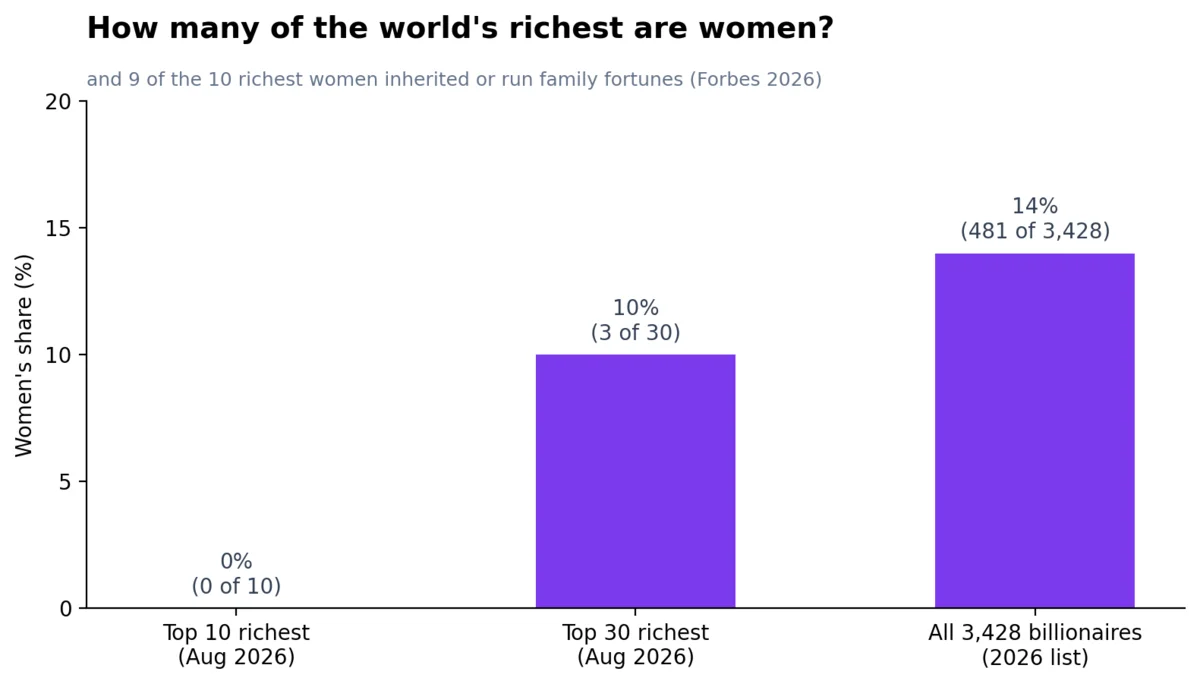
Keep that in mind for everything below: any claim about “how billionaire women behave” is a claim about a few hundred people, most of whom got the money by birth or marriage rather than by IPO.
The scoreboard
Second problem: the closest published thing to the metric I wanted is Forbes’ 1-to-5 philanthropy score, which is tiered rather than continuous, covers only the 400 richest Americans, and lives behind a paywall. What I wanted was simpler: what share of your accumulated fortune have you verifiably parted with? So I built it for everyone I could find a sourced lifetime-giving number for: giving divided by giving-plus-current-net-worth. One weakness to keep in view: gifts are valued on the day they left while fortunes are valued today, which flatters recent givers. Buffett’s dollars left mostly in decades when Berkshire shares were far cheaper; count shares instead of dollars and his bar grows a lot.
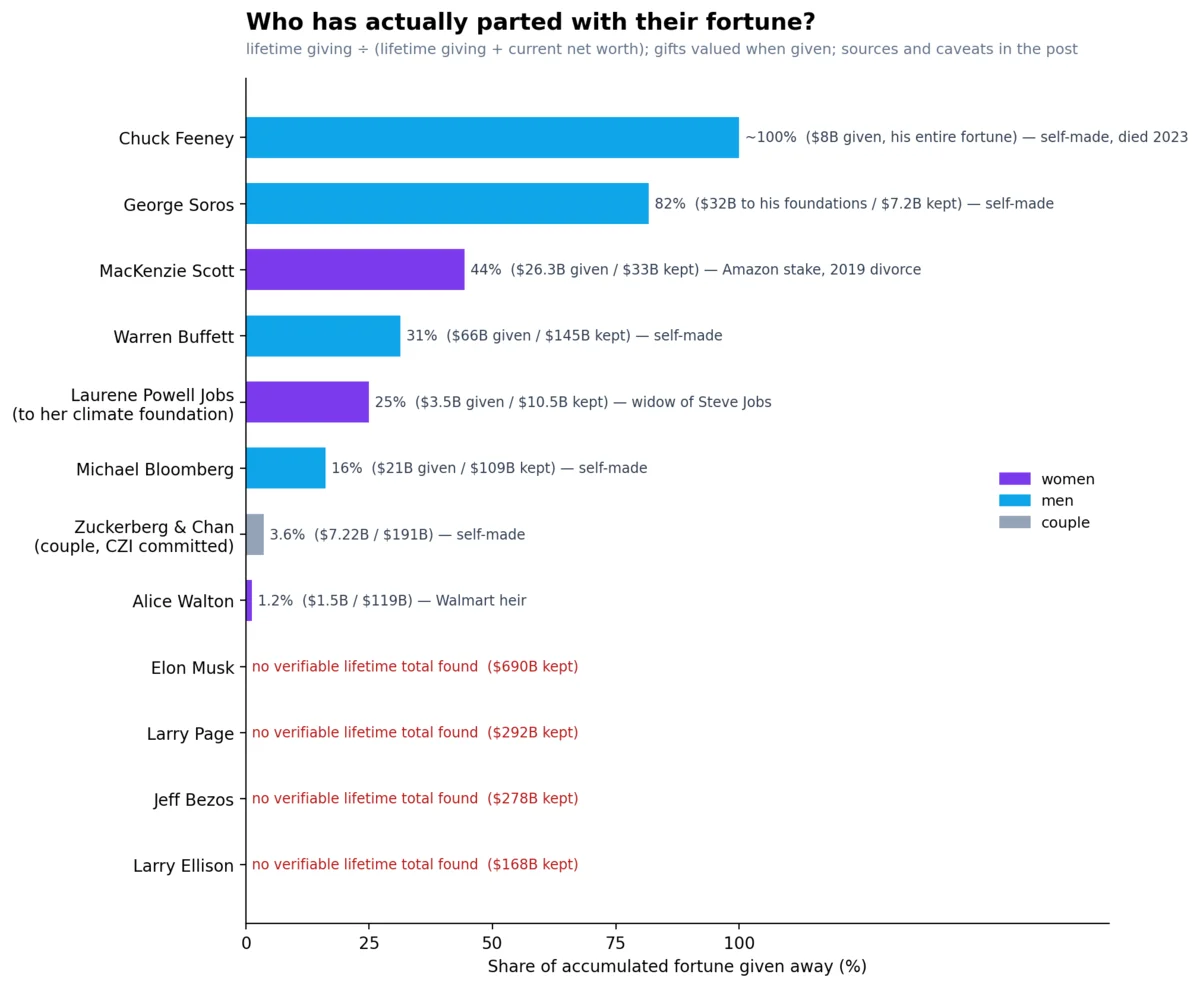
Some honest reading of my own chart:
- The biggest absolute givers are men. Buffett had moved roughly $60B through mid-2025 at value-when-received, plus another ~$6B in June 2026. Soros has put $32B into Open Society, roughly $21B of it distributed by 2024. Bloomberg has donated more than $21B. The two highest shares on my chart also belong to men: Soros, and Chuck Feeney, who gave away his entire $8B and finished the job while alive. Feeney is the only person on this chart who finished the job of giving it all away, though in fairness, finishing is also the only way to score 100%.
- The fastest sustained giver of unrestricted money to working nonprofits is a woman. MacKenzie Scott has moved over $26 billion in 2,700+ gifts since 2019, including $7.1B in 2025 alone, no strings attached, straight to operating nonprofits. Buffett’s larger totals flow into foundations (his family’s, and until recently the Gates Foundation) that spend the money over years.
- The richest heiress has parted with about 1%. Alice Walton’s lifetime giving runs $1.5B, mostly to the arts, against a $119B fortune: 1.2% by my formula, or 1.64% by Forbes’ 2024 accounting, its second-lowest tier either way. Her tuition-free medical school is real. So is the other 98.8%. Julia Koch’s family foundation, established in 2023, made some of its first grants in 2024, against an $81B fortune. Françoise Bettencourt Meyers, the L’Oréal heiress, has no disclosed lifetime total at all.
- Most of the top ten have no verifiable number at all. The zero-length bars aren’t me claiming Musk and Bezos have given nothing; they mark the absence of any sourced lifetime out-the-door total. Forbes’ February headline says it plainly: Musk, Page, and Ellison don’t make America’s top-25 philanthropists list. Nothing about a $690 billion fortune requires disclosure, and nothing gets disclosed.
Whatever sorts this chart, it isn’t gender.
It’s not gender, it’s how the money showed up
Look at the three women with real bars. Scott’s fortune arrived in 2019 as a 4% Amazon stake in her divorce. Laurene Powell Jobs inherited from Steve Jobs and has since moved $3.5B into her climate foundation (her bar uses Bloomberg’s $10.5B estimate; published figures run as high as $15B, which would drop it to 19%). Melinda French Gates left the Gates Foundation in 2024 with $12.5B from Bill, personally, earmarked for her own charitable work, and separately pledged $1B over two years for women’s rights. The money she has committed to move is bigger than the $11.3B Forbes pegged her at in mid-2024.
The pattern that jumps out of my little dataset isn’t “women give more.” It’s that women who suddenly got control of a self-made man’s fortune treat it as something to deploy, and heirs of either sex treat it as something to steward. Scott, Powell Jobs, and French Gates behave like Feeney. Walton and Koch behave like the Walton brothers. It’s a hypothesis on n = 8, not a finding, but it fits everything on the chart.
One more detail from the pledge world: among Giving Pledge signatories as of 2019, just 6% were women pledging alone, versus 37% men alone. Women barely appear in elite philanthropy as independent actors because, until very recently, they barely appeared in elite wealth as independent actors.
The scoreboard is rigged against the generous
Here’s my favorite statistical trap in this whole exercise: wealth rankings are blind to generosity in at least three different ways.
The first is exit. Give away enough and you disappear from the data. Soros moved his $32B and now sits at $7.2 billion, nowhere near any top-30 list; Feeney gave until he vanished from the rankings entirely. Measure generosity by studying the people still on the list and you have selected for the people who kept the money: a textbook case of survivorship bias.
The second is that appreciation can bury giving completely. Scott’s net worth was $27B in December 2022 after $14B given, and $33B in December 2025 after $26.3B given. Amazon stock refills her tank faster than she can drain it, so a net-worth scoreboard registers seven years of historic giving as a gain. TIME dryly notes she has “$40 billion or so to go”.
The third is methodology. The Chronicle of Philanthropy’s top-50 donors list for 2025 totals $22.4B and crowns Bloomberg at $4.3B, and Scott, who gave $7.1B that year, isn’t on it. The most-cited top-donors list omits the top donor.
Meanwhile the Giving Pledge, 250+ signatories strong, is aging badly: an Institute for Policy Studies analysis found exactly one living couple among the original 57 signatories, John and Laura Arnold, has actually given away half, while the 32 original US pledgers who are still billionaires have grown roughly 283% richer since signing. A pledge is a press release. A wire transfer is a fact.
What the research actually says
There is a real academic literature here, and it’s better than my twelve-bar chart.
At the population level, the “women give more” result is solid. The Women’s Philanthropy Institute’s Women Give 2010 study, using the single-headed households from a panel of nearly 8,000 and controlling for income, wealth, and education, found single women were 26-49% more likely to give than single men in every income quintile, and in three of the five income brackets gave roughly twice as much.
But the closer you get to this post’s actual question, the weaker it gets:
- WPI’s own follow-up across three datasets, Do Women Give More?, reports that “high net worth single women and single men do not significantly differ in their likelihood or amount of giving.” Two footnotes before anyone extrapolates that to billionaires: “high net worth” in the underlying survey means millionaire households (net worth above $1M excluding the home, or income above $200K), which is three or four zeroes short of the people in my chart; and a null in a smaller subsample can just mean underpowered. What’s fair to say is that the gap that’s unmistakable in the general population has not been detected in the wealthiest sample anyone has actually surveyed, and nobody has surveyed billionaires.
- It doesn’t travel well either: in the Netherlands, men donate higher amounts than women, even though women remain more likely to give something.
- Even within the US data there are reversals: widowers out-give widows about two to one, and in the second income bracket from the bottom (roughly the 20th to 40th percentile), single women give 32% less than single men.
- In the lab, two large meta-analyses of dictator games (Bilén, Dreber & Johannesson 2021; Doñate-Buendía et al. 2022) agree women give more, but the effect is small: about 4 percentage points (Cohen’s d = 0.16) in Bilén and colleagues’ raw-data analysis. It roughly triples when the recipient is a charity. Fun twist from a classic QJE experiment: when giving is expensive women are kinder, when it’s cheap men are, and the demand curves literally cross.
- And the researchers themselves refuse the essentialist reading. The standard review of gender differences in preferences concludes women are “neither more nor less socially oriented, but their social preferences are more malleable”. WPI’s own director credits socialization, women being raised as the family’s caretakers of community, not something written into a genome.
So the strongest honest sentence I can write is this: ordinary women out-give ordinary men reliably; wealthy women and wealthy men look the same in the best data we have, which taps out around millionaire households; billionaires are unsurveyed; and the whole difference looks trained rather than innate.
So would the world be better if women held the money?
I wanted the data to hand me a tidy yes, and I’m not going to pretend it did. The same discipline applies to the adjacent claim I hear a lot (and have repeated): that countries led by women handled COVID better. One matched study of 194 countries found exactly that; a separate analysis, published first, found the difference not statistically significant and blamed the narrative on which countries the Western press looks at. Both studies were stuck with the same problem as my billionaire chart: only ~16-19 countries had women in charge. You cannot cleanly study a group you’ve mostly excluded from the treatment.
But “the data didn’t prove women are better” is not the same as “nothing here matters.” Three things from this exercise actually matter to me:
- The question is unanswerable at the top because we never ran the experiment. Women are 14% of billionaires, mostly by inheritance. No generation of women has yet built and controlled wealth at the very top of the distribution, so the evidence never had a chance to exist.
- The closest thing we have to the experiment is striking. When a woman got sudden, unilateral control of a top-five fortune, what she did with it was $26.3B of unrestricted gifts in seven years: no naming rights, no application process, a website that is essentially a receipt pile. And the researchers who study her grantees report it works: the Center for Effective Philanthropy’s three-year study found the gifts strengthened nonprofits’ finances and their community impact, with nearly 90% of leaders reporting no negative consequences. It’s a sample of one. It’s also the sample we’ve got.
- Generosity being socialized rather than innate is the good news. If giving were a fixed trait, we’d be stuck with whoever holds the money. If it’s trained, then it’s a norm, and norms move. And the person modeling this one was just about the only public figure Democrats and Republicans still agreed on: in a March 2026 UMass Lowell/YouGov survey, 70% of Americans viewed Dolly favorably, twenty points clear of the runner-up, Barack Obama. A norm needs a carrier with reach into both tribes, and she was the last one we had. Dolly wasn’t born generous any more than Musk was born hoarding; she grew up dirt poor, a Pentecostal preacher’s granddaughter who tithed her whole life, and spent the next fifty years practicing.
The house that Whitney built

Which brings me back to the strip mall, and to one last thing the scoreboards would miss about Dolly herself: she was never a billionaire. Estimates of her fortune at her death run from Forbes’ $450 million to the $650 million other outlets report, while the same reporting puts her lifetime giving above $600 million. She gave away roughly as much as she kept, quite possibly more. Put the two piles back together and she clears a billion either way: she could have joined the billionaires’ club, and chose the other club instead, the one with Chuck Feeney in it, the one no wealth ranking can see. The engine of it was the Imagination Library, the program she launched in her home county in Tennessee in 1995: a free book in the mail every month for any child from birth to five, no income test, no application, no strings. It gifted its 200-millionth book in 2023 and was running at 3.5 million books a month when she died. Universal, unconditional, and quietly enormous. Scott’s model had a prototype.
Her whole move with the complex, taking a windfall that arrived through another woman’s voice and planting it in that woman’s honor in a neighborhood the money economy had written off, isn’t in any regression I can run. Sample size of one, again. But it’s a demonstration of the thing the literature keeps gesturing at: generosity as a reflex you build, not a trait you’re issued.
The richest list will belong to men for a while yet; the structural reasons are a different angry post. What the women who got sudden control of big fortunes keep demonstrating, and what ordinary women demonstrate in the household data, is what money looks like when it’s treated as something that’s supposed to leave. That’s the experiment I’d like to see run at full scale. Not because women are angels; the data won’t support that and doesn’t need to. Because the people who currently hold most of the money have had their run, and the scoreboard reads: 283% richer, one pledge fulfilled.
Dolly didn’t wait for the study. She heard her own song come back to her transformed, cashed the check, and built a house with someone else’s name on it.
Go build somebody a house.
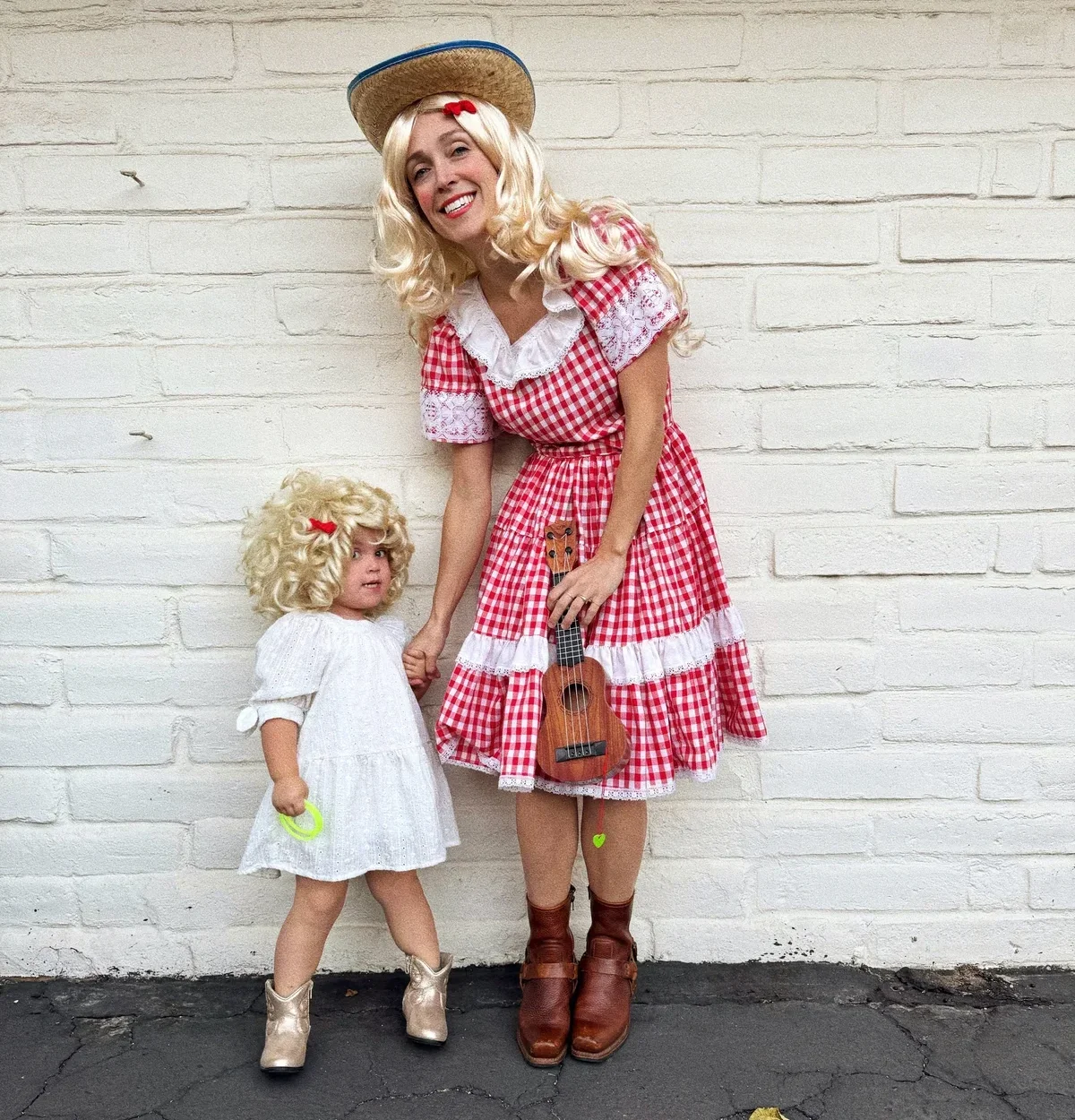
Promised Dolly scholarship, delivered: two Halloweens ago, my wife and daughter both went as Dolly. After the news broke last week, my wife posted the sequel, and it’s the best thing on the internet this month: our daughter, in costume, singing “Jolene.” Swipe to the second slide for the video.
View the post on Instagram
Reference Links
Dolly, Whitney, and the complex:
- NPR: Dolly Parton obituary
- NPR (2021): the Watch What Happens Live story and the royalties
- CNN (2021): Dolly invested Whitney cover royalties in a Black Nashville neighborhood
- ABC7 (2021): the Watch What Happens Live appearance
- WSMV: fans honor Dolly at the 12South complex
- Wikipedia: “I Will Always Love You” chart history
- Yahoo: Dolly’s $450-650M net worth and $600M+ given away
- Religion Unplugged: Dolly’s faith and lifelong tithing
- Yahoo: the March 2026 UMass Lowell/YouGov favorability survey
Who the richest are:
- Forbes: 2026 World’s Billionaires list facts and figures
- Forbes Australia: top 10 richest, August 2026 (also Walton’s $119B)
- Forbes: the richest women in the world 2026
- Forbes billionaires index snapshot, Aug 7 2026 (Bloomberg’s $109B)
- Altrata: the defining characteristics of ultra-wealthy women
- Wikipedia: George Soros ($7.2B net worth, May 2025, per Forbes)
The giving numbers in the chart:
- Yield Giving (MacKenzie Scott’s running total)
- CBS: Scott’s $7.1B in 2025, $26.3B since 2019
- CBS (2022): the $14B / $27B checkpoint
- TIME100 Philanthropy 2026: MacKenzie Scott
- CBS: Buffett’s June 2025 gift and ~$60B lifetime
- Yahoo Finance: Buffett’s June 2026 ~$6B gift and 2034 plan
- Open Society Foundations: Soros has given over $32B
- Fortune via Yahoo: Soros at 76%, Buffett at 30%, the Arnolds, and the 283% stat
- Atlantic Philanthropies: Chuck Feeney’s completed $8B
- TIME100 Philanthropy 2025: Bloomberg’s $21B+
- PBS: Gates Foundation’s $100B spent, 41% from Buffett, closing 2045
- Chan Zuckerberg Initiative: $7.22B in grants committed
- TIME100 Philanthropy 2025: Alice Walton
- The Conversation: Walton’s 1.64% and why billionaire philanthropy underwhelms
- NYU Langone: Julia Koch Family Foundation’s $75M gift
- Bettencourt Schueller Foundation
- abc Money: Laurene Powell Jobs’ wealth and $3.5B climate transfer
- Gulf News: Scott’s 4% Amazon stake in the 2019 divorce
- Al Jazeera: French Gates’ $12.5B exit
- AP via OPB: French Gates’ $1B pledge
- Forbes: America’s top 25 philanthropists, and why Musk, Page and Ellison aren’t on it
- Foundation Source: the 2025 Philanthropy 50
- Center for Effective Philanthropy: three-year study of Scott’s unrestricted gifts
The research:
- Women’s Philanthropy Institute: Women Give 2010 (PDF)
- Women’s Philanthropy Institute: Do Women Give More? (PDF)
- De Wit & Bekkers: the Dutch case
- Bilén, Dreber & Johannesson: Are women more generous than men? A meta-analysis
- Doñate-Buendía et al.: Gender and other moderators of giving in the dictator game
- Andreoni & Vesterlund: Which Is the Fair Sex? (PDF)
- Croson & Gneezy: Gender Differences in Preferences
- SSIR: Whether women are more generous than men, and whether it matters
- The Conversation: MacKenzie Bezos’s pledge and the growing list of women giving big
- Garikipati & Kambhampati: women leaders and COVID (working paper PDF)
- Windsor et al.: gender and COVID fatalities, PLOS ONE
- Giving Pledge
Related Posts
School Gets Out at 12:05 on Thursdays
California just gave my daughter free transitional kindergarten, and I'm thrilled. Then I saw the bell schedule. A data-driven look at how American school days and American work days stopped speaking to each other.
If 3.5% of Us Protest, We Win
We need 11.9 million people to show up to the No Kings protests this weekend. Here is the data on why nonviolent resistance actually works.
Zohran's Math: Can Taxing the 1% Really Pay for Free Buses, Childcare, and Rent Freezes?
NYC's mayor-elect wants to tax millionaires 2% more and raise corporate taxes. I crunched the numbers – and dreamed bigger.