
North Dakota Was 1,445 Voters Away From Free School Meals
Published on • 9 min read
On Tuesday, November 3, North Dakota voted on whether every kid in a public school gets breakfast and lunch for free.
This is a state where Donald Trump won 67% of the vote in 2024. Republicans won every partisan statewide race on this year’s ballot by 21 to 28 points. And free school meals lost by 2,889 votes, out of 235,415 cast.
Same night, same ballots, the measure ran about 13 points ahead of the Democrat for the U.S. House. I keep coming back to that number.
A Blue Wave That Skipped North Dakota
The national story on November 3 was a Democratic wave. According to AP race calls, Democrats won control of both the House and the Senate, including Senate seats in some unlikely places. Texans elected their first Democratic senator since Lloyd Bentsen in 1988. South Carolinians elected their first since Fritz Hollings in 1998. Kansans elected their first since George McGill in 1932. (Every 2026 count in this post is still unofficial. States certify over the next few weeks.)
I think that wave means more social programs over the next few years, and free school meals are an easy one to imagine. Nine states already have some version of them.
North Dakota is not in that wave. Its Democrats got 36 to 39% statewide. Measure 2 was not a blue-state idea riding a blue-state night. It was a deep-red electorate getting within about a point of feeding every kid at school.
The Numbers
From the Secretary of State’s unofficial results, with all 358 precincts in:
- Yes: 116,263 (49.39%)
- No: 119,152 (50.61%)
If 1,445 people who voted no had voted yes instead, it would have passed.
No recount. North Dakota recounts a ballot measure automatically only when the margin is a quarter of a percent or less, and only candidates can demand one (N.D.C.C. 16.1-16-01). This margin is about 1.2%.
Certification. The state canvassing board meets by November 20 (N.D.C.C. 16.1-15-35). Canvasses fix errors, but 2,889 is a lot of errors.
It Beat the Democrat Everywhere
So I lined up Measure 2’s yes share against the Democrat’s share in the U.S. House race, county by county.
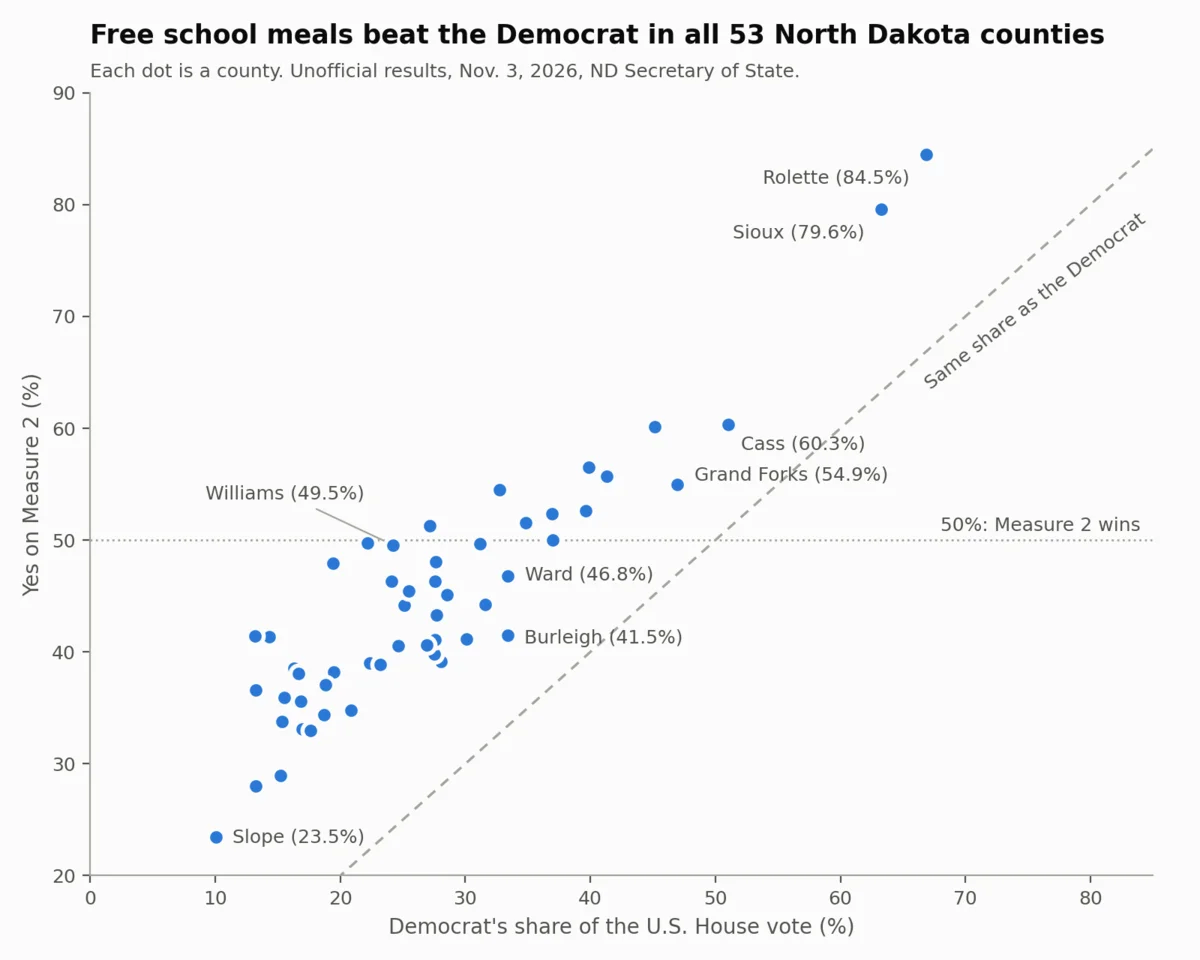
- All 53 counties sit above the line. Yes ran ahead of the Democrat in every one, by 8 to 29 points (the median gap was 16.5).
- Yes won 14 counties. In nine of them, Republican Julie Fedorchak won the House race with a majority.
- One county was decided by one vote. Sargent County went yes, 745 to 744. If you live in Sargent County and voted, you were right to.
A county chart can’t tell you exactly who crossed over. But the arithmetic sets a minimum. Every yes voter either voted for the Republican for Congress, voted for someone else, or skipped that race. Suppose everyone in the last two groups voted yes. The rest of the yes votes still had to come from people who voted for the Republican:
| Votes | |
|---|---|
| Yes on Measure 2 | 116,263 |
| minus votes for the Democrat | −85,892 |
| minus votes for the two independents and write-ins | −14,226 |
| minus ballots that skipped the House race | −4,462 |
| Yes voters who must have voted for the Republican | 11,683 |
The 4,462 is 239,057 ballots cast minus 234,595 House votes. If anyone in the last three rows didn’t vote yes, the real number is higher.
The Case For and Against It
Measure 2 was a constitutional amendment. Starting in 2027-28, every public and charter school would serve every student a free breakfast and lunch, and private and tribal schools could opt in. The state would top up federal money, with the Legacy Earnings Fund as a backstop. The ballot printed the price: $124.3 million to $134.3 million more every two-year budget.
Supporters argued that serving every kid removes the stigma of being the free-lunch kid (KXNET). There’s evidence for that. In New York City middle schools, universal free lunch raised participation by 5.4 percentage points even among poor students, whose lunch was already free or close to it. The researchers say that suggests “stigma plays a role” (Schwartz and Rothbart).
The governor’s objection wasn’t to feeding kids. It was to putting the spending in the constitution, and to the price. Gov. Kelly Armstrong said in July he’d vote no:
“I don’t like constitutional mandated spending at all. Because by its nature, you are saying this is the single most important thing that exists.”
He called school lunches “a very important debate,” but added: “I do not think it is the most important $140 million under any circumstance that North Dakota would spend.”
Others argued the kids were already covered. In January, State Sen. Janne Myrdal said: “We are becoming a welfare state. All of our kids in schools right now are fed. There are no hungry kids in school because we passed a law, even, to ensure that.”
Others said it would mean more food in the trash (KXNET). I checked, and it’s half right. Schools do waste a lot: in USDA’s national study, lunches lost about a fifth of their calories, 31% of their vegetables and 29% of their milk (USDA). But that happens whoever pays. USDA’s data hint at a bit more waste where meals were free for everyone, but USDA calls that exploratory. A 2024 review found no rigorous study of universal meals that measured waste at all (JAMA Network Open), and North Dakota doesn’t measure it either: in March, the Department of Public Instruction told a legislative committee it doesn’t monitor food waste in schools (minutes). In a 2026 study of 20 elementary schools, statewide free meals weren’t linked to kids eating less, but short lunches were (Nourish Lab). Free meals do mean more kids eating, so more total food in the trash. That argues for longer lunches, not fewer kids fed.
It had been close before, too. In a special session in January, a bill from Republican Rep. Mike Nathe to do the same thing by ordinary law passed the House 55 to 38 and died in the Senate, 22 to 24. Two votes in January. 2,889 in November.
For now, the law stays where it was: free meals for kids in families up to 225% of the federal poverty line, with $6 million set aside for 2025-27.
Do We Actually Agree on This?
Here’s what I’d like to see, and what I think most people can agree on: kids deserve to be fed, to see a doctor, and to have a home. Not as a reward for their parents’ income.
The most quotable support for that came from the measure’s opponents. After the vote, Sen. Paul Thomas, a Republican who debated against Measure 2, told the North Dakota Monitor:
“Nobody in North Dakota feels or has any belief that a child should ever not be fed. This really isn’t a partisan Republican-Democrat divided issue.”
So I went looking for polls. They mostly agree, with one big catch.
- Food. In an August 2025 YouGov poll, 81% of Republicans and 97% of Democrats said public schools should give free lunch at least to low-income students (crosstabs). Free lunch for all students got 72% of Democrats but only 44% of Republicans.
- Health care. In another YouGov poll that month, 72% of Republicans and 95% of Democrats supported Congress increasing funding for health care for families with children (crosstabs).
- Housing. The same poll found 59% of Republicans and 92% of Democrats supported more funding for affordable housing for families with children. That’s the weakest of the three.
The catch is the word “all.” Republicans who back meals for poor kids split when it’s every kid. A 2024 study in JAMA Health Forum found the same thing from another angle: fewer than half of Republican voters would back a candidate who strongly supports national funding for free school meals (46%) or summer meals (36%).
North Dakota may be a live example. A 2024 poll for the North Dakota News Cooperative found 76% of the state’s Republicans supported free meals at school, though the question didn’t say “every student” or name a price. Two years later, written into the constitution with a price of up to $134 million on the ballot, the measure fell just short.
My read: the agreement is real. Across parties, most people want poor kids fed, and families with kids helped with health care. The fight is over whether “need” is the test, and over who pays.
Where It Goes From Here
The fight moves to the Legislature in January. Rep. LaurieBeth Hager, a Fargo Democrat, plans to bring universal meals back as an ordinary law: “The fight continues.” Sen. Thomas is drafting his own bill, with bigger portions, better food and weekend meals, and doesn’t support Hager’s. Gov. Armstrong expects no big Republican push for universal meals: “I just think it’s a little harder politically today than it would have been even six months ago” (same story).
I’d bet on North Dakota getting there anyway. Not this session, maybe. But a measure that runs 13 points ahead of the party that usually champions it isn’t a fluke. It’s a preview.
Free is half of it. The other half is what’s on the tray, which is what my school meal tracker watches every week. Next month I’ll put both halves together: mostly red states are banning food dyes, mostly blue states are paying for lunch, California is doing both, and I’m counting the sugar and fiber.
Feeding kids lost by about a point in a state where Trump won 67% of the vote. I’ll take that trend.
Reference Links
North Dakota results, law and testimony:
- Secretary of State: 2026 general election results (unofficial)
- Secretary of State: 2024 general election results (official)
- Measure 2 full text
- N.D.C.C. chapter 16.1-16: recounts
- HB 1624 (2026 special session)
- Legislative Audit and Fiscal Review Committee minutes, March 24, 2026
Reporting:
- North Dakota Monitor, via Wahpeton Daily News: School meals focus shifts to the Legislature
- Valley News Live: Gov. Armstrong to vote against school meals ballot measure
Research and polls:
- USDA School Nutrition and Meal Cost Study, Volume 4 (PDF)
- JAMA Network Open: universal free school meals, a systematic review (2024)
- YouGov: Back to School poll, August 2025 (PDF)
- YouGov: Family Policy and Child Care poll, August 2025 (PDF)
- JAMA Health Forum: voter support for child and family policies (2024)
Mine:
Related Posts
You Can Read Your Kid's School Lunch Menu. You Just Can't Compare It.
I built a tracker for what US school districts actually serve kids. Then I found out that 20 of the 25 biggest districts publish their menus through two apps whose terms of use, as best I can read them, rule out collecting and republishing them.
School Gets Out at 12:05 on Thursdays
California just gave my daughter free transitional kindergarten, and I'm thrilled. Then I saw the bell schedule. A data-driven look at how American school days and American work days stopped speaking to each other.
Dolly's Generous Legacy: Do Rich Women Give More Than Rich Men?
Dolly Parton gave away about as much money as she kept. Her death sent me to the data: do the world's richest women give more than the richest men?