I Spent 16 Years on YouTube. A Bot Deleted Me in a Day.
Published on • 10 min read
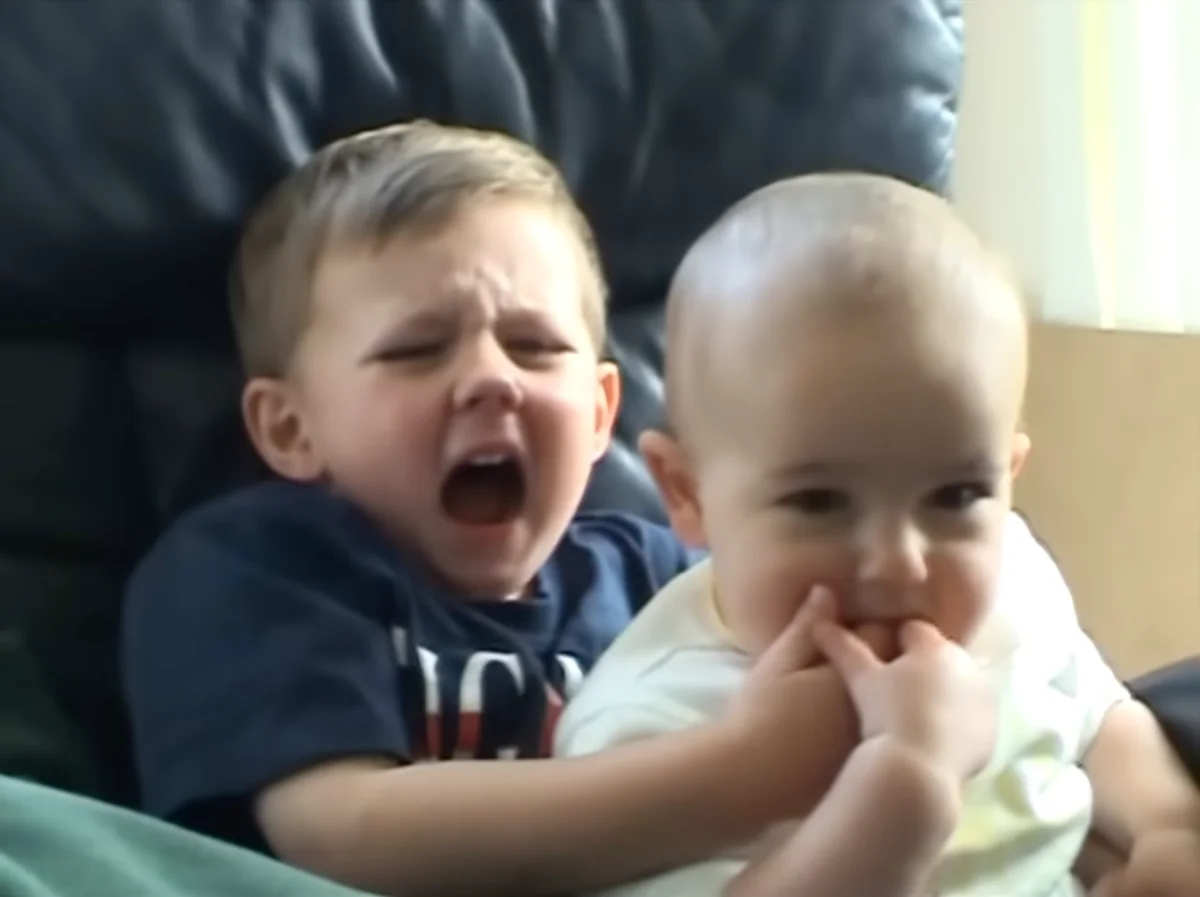
I joined YouTube in September 2009, back when the cutting edge of the platform was a baby biting his brother’s finger. For sixteen years I was a model citizen: I watched, I subscribed, I left the occasional comment, and for the last ten years or so I even paid Google every month for music. Sixteen years, zero strikes, zero warnings.
Then, on June 16, without a single notice, Google deleted all of it. Account, history, playlists, the works. I appealed. The appeal was rejected in less time than it takes to microwave a burrito.
I’m a data scientist. I build models that sort things into buckets for a living. So I want to walk through exactly what happened, because I think I recognize the machinery, and I don’t think a human was ever in the room.
Sixteen Years a Model User
Let’s establish the prior, as we say in the business. I am not, by any reasonable definition, a spammer.
- 2009: Joined YouTube. Used it the way most people do, as a glorified TV that occasionally teaches you to fix a dishwasher.
- 2016: Started paying for Google Play Music, largely because I wanted ad free YouTube, but also because I didn’t trust that peppy new kid on the block, Spotify.
- The last year: Became a heavy user of NotebookLM, Google’s own AI product, to help produce a podcast. Never once flagged for spam or abuse.
In sixteen years I never received a strike, a warning, a “hey, knock it off” email, nothing.
And then it was gone.
The Deletion
There was no warning. There was no “you have 30 days.” There wasn’t even a specific video pointed to as the problem. One morning the account simply did not exist, and an email informed me that this was permanent.
FROM THE TERMINATION EMAIL:
“We have reviewed your content and found severe or repeated violations of our spam, deceptive practices and scams policy. Because of this, we have removed your channel from YouTube.”
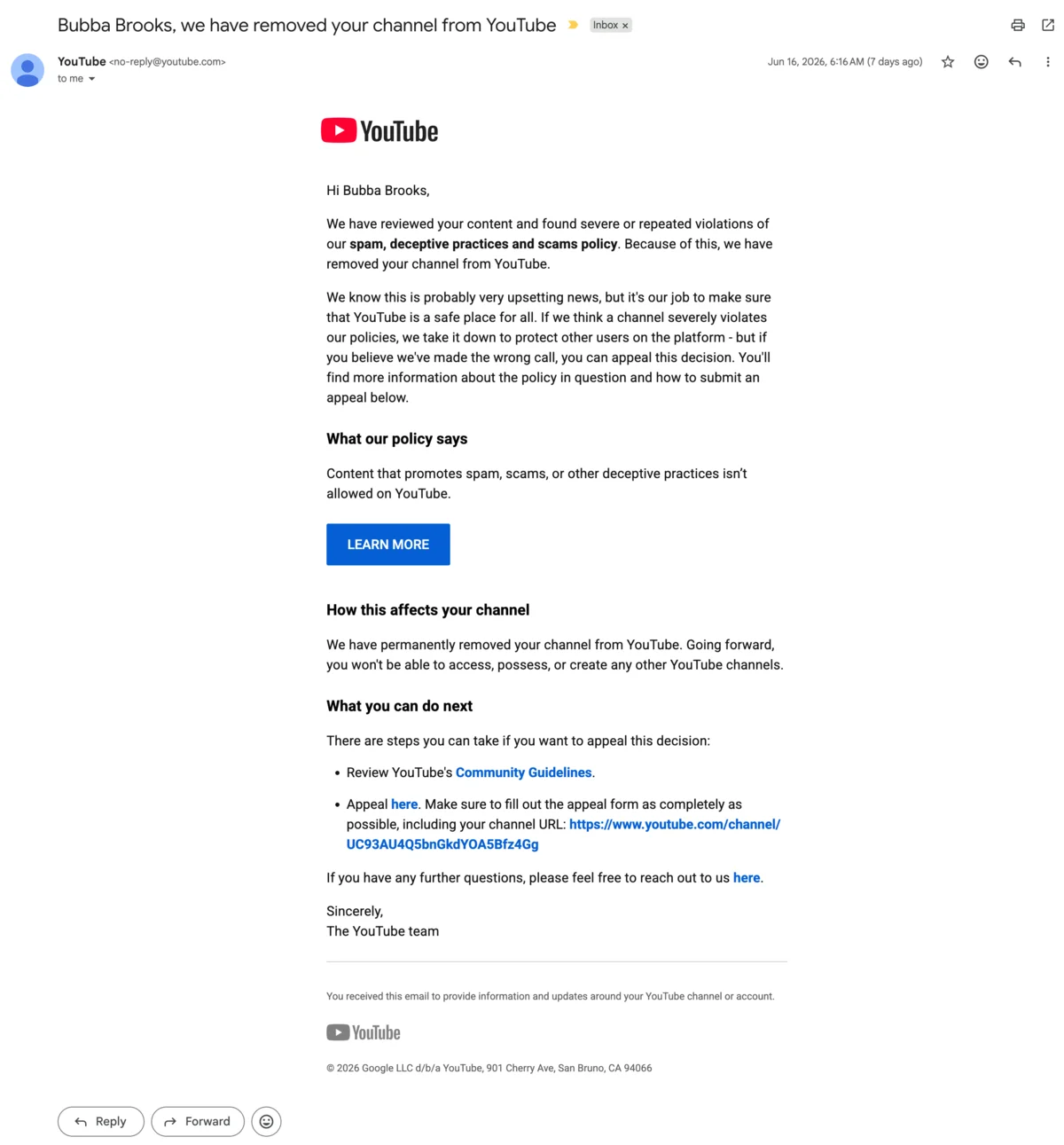
So they did name a policy. What they didn’t name was a single piece of offending content: not a video, not a comment, not a post, not a thumbnail. And “spam, deceptive practices and scams” is less a reason than a filing cabinet, a giant bucket of unrelated offenses. Telling someone who posts sourced political commentary that he committed “spam” narrows it down about as much as telling him he “broke a law.” No scalpel, no surgery. Just the guillotine for the whole account.
The Only Clause That Even Fits
Out of professional curiosity I read all nine sub-clauses of the policy they cited. I’ve never run a sub-for-sub ring, posted malware, faked a customer-support line, or re-uploaded other people’s videos. Eight of the nine don’t describe me even slightly. The one that’s left is about AI:
Automated or synthetic mass-production: Using automated tools or AI to churn out high volumes of similar content… repetitive AI generated imagery across many videos, with each video reading out an AI-generated script.
Reader, I make a podcast with NotebookLM. Which is Google’s own AI product. So the most charitable reading of my own deletion is that Google’s spam filter flagged content I produced with Google’s AI, under a rule about AI content, and then mentioned none of it. The snake isn’t just eating its tail. It’s issuing the tail a permanent ban.
But even that explanation falls apart on contact. I’ve been making these since May 2025, seven of them now, posted to YouTube and embedded across more than a year of writing (the lapel-pins press conference, the Kushner confirmation, and on). If “AI mass-production” were the real trigger, YouTube had thirteen months and seven videos to notice it, warn me, and start the strike clock. It never did. The pattern they supposedly terminated me for is the exact pattern they tolerated without a peep for over a year.
The Appeal (Denied Before My Afternoon Coffee)
So I appealed, and explained that I’d been a quiet, paying user for sixteen years. The rejection came back almost immediately.
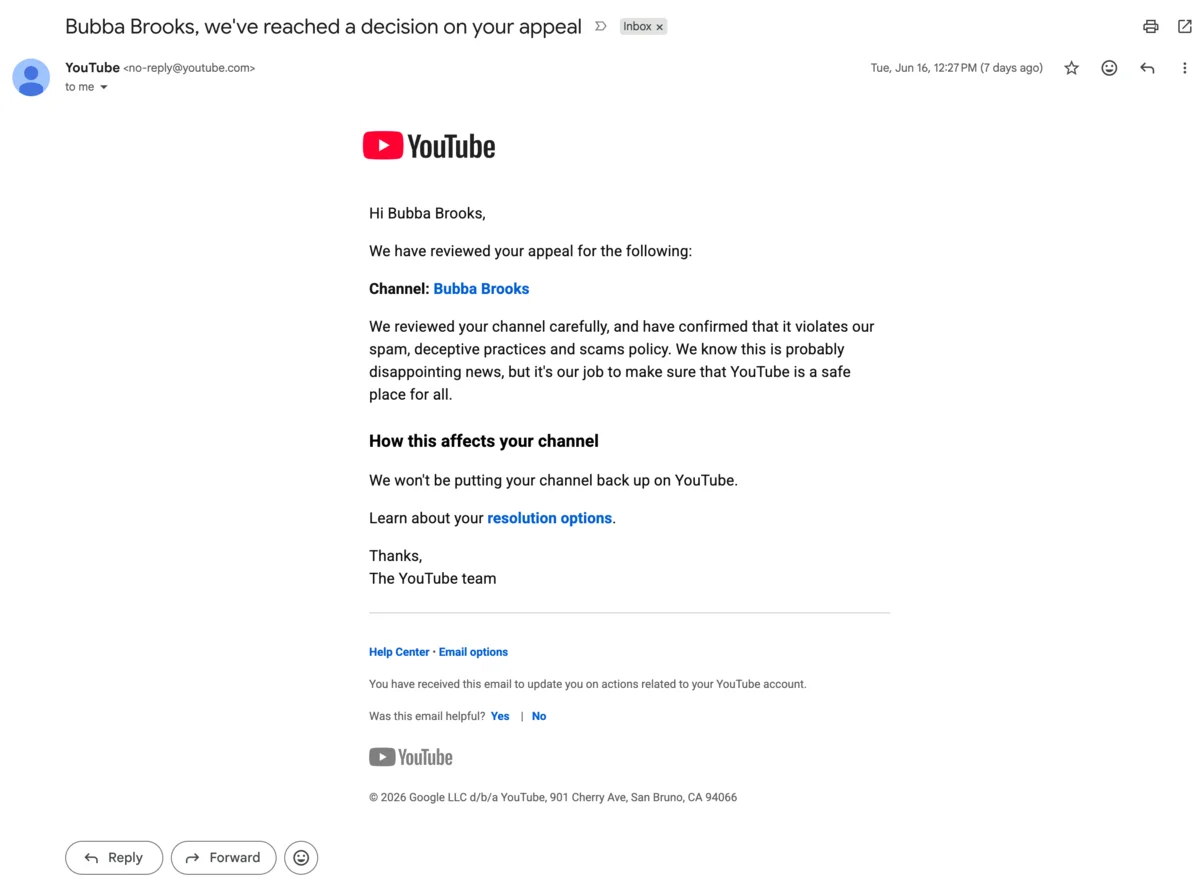
I’m not special here, and that’s the point. In November 2025, enough creators reported appeals being rejected in under a minute that YouTube had to put out a public statement defending its process. People did the obvious math: even a cursory human review of an account takes longer than sixty seconds. The appeal isn’t a second opinion. It’s the same model, asked the same question, returning the same answer.
YouTube’s published policy is blunt about it too: you get one appeal per termination, full stop. One.
Their Own Rules Promise Three Strikes. I Got Zero.
Here’s the part that curdles. YouTube’s strike system is built in stages: a warning with an email, then a first strike with an email, then a second, then a third. Three strikes in 90 days before a channel is terminated, with an optional training that even lets a warning expire.
I got none of it. No warning, no strike, no email of any kind until the one announcing it was over and permanent. The instant-death path is reserved for “severe” cases, and sure enough the email pre-labeled mine “severe or repeated.” Which leaves the uncomfortable question: what about a 16-year-old account quietly posting sourced political criticism is so severe that it skips every guardrail Google built for exactly this situation? I can think of one recent post that was louder than the rest, and it wasn’t about AI.
Why I Think a Robot Pulled the Trigger
Here’s where the data scientist in me starts narrating.
YouTube is refreshingly honest that this is a machine’s job. By their own transparency reporting, automated systems are the first detector for the overwhelming majority of removed content, and Google has bragged that automation catches the vast majority of violations before they get meaningful views. Independent coverage puts the automated share of enforcement north of 90%. At YouTube’s scale this is the only way moderation can physically work, and I’m not mad at the math. I even understand the impulse behind it: nobody wants YouTube to turn into the kind of AI slop factory that Sora became, OpenAI’s video app that drowned in deepfakes and synthetic sludge until the company pulled the plug six months after launch. Guarding a platform against that is a genuinely good goal.
The problem is what these models are bad at. They are, by repeated documentation, terrible at context. They miss sarcasm. They miss satire. Researchers keep finding that classifiers systematically misread speech that is emotionally charged or politically critical, flagging protest as the very thing it’s protesting.
Which brings me to my most recent, most-shared piece of writing: “The New King George: 250 Grievances for the Semiquincentennial,” a long, fully-sourced catalog of 250 documented things the administration has actually done, every entry footnoted. Not satire, not a joke: an itemized indictment, harsh and emotionally charged and entirely factual. In other words, exactly the kind of content that automated moderation is documented to over-flag.
So here is my speculation, clearly labeled as speculation: I think a model flagged my political writing, and a second model rubber-stamped the appeal, and at no point did a human being look at sixteen years of an account and ask whether any of this made sense.
Can I prove Google tuned its classifiers to be extra twitchy about content critical of this particular administration? No. I can’t. Maybe it was a random false positive. Maybe it was mistaken identity, a bad batch, a cosmic ray. But the timing lines up with my most pointedly anti-Trump post, the punishment was total rather than surgical, and the “appeal” was decided at a speed that rules out human judgment. When you’ve built enough classifiers, you stop believing in coincidences and start believing in thresholds.
The Collateral Damage
Two things drove home that this wasn’t a clean removal of a single bad video. It was the deletion of me.
First, my feed. Sixteen years of curation, subscriptions, and watch history, wiped overnight and replaced with a generic grid of algorithmic slop: the YouTube homepage of someone who has never expressed a single preference.
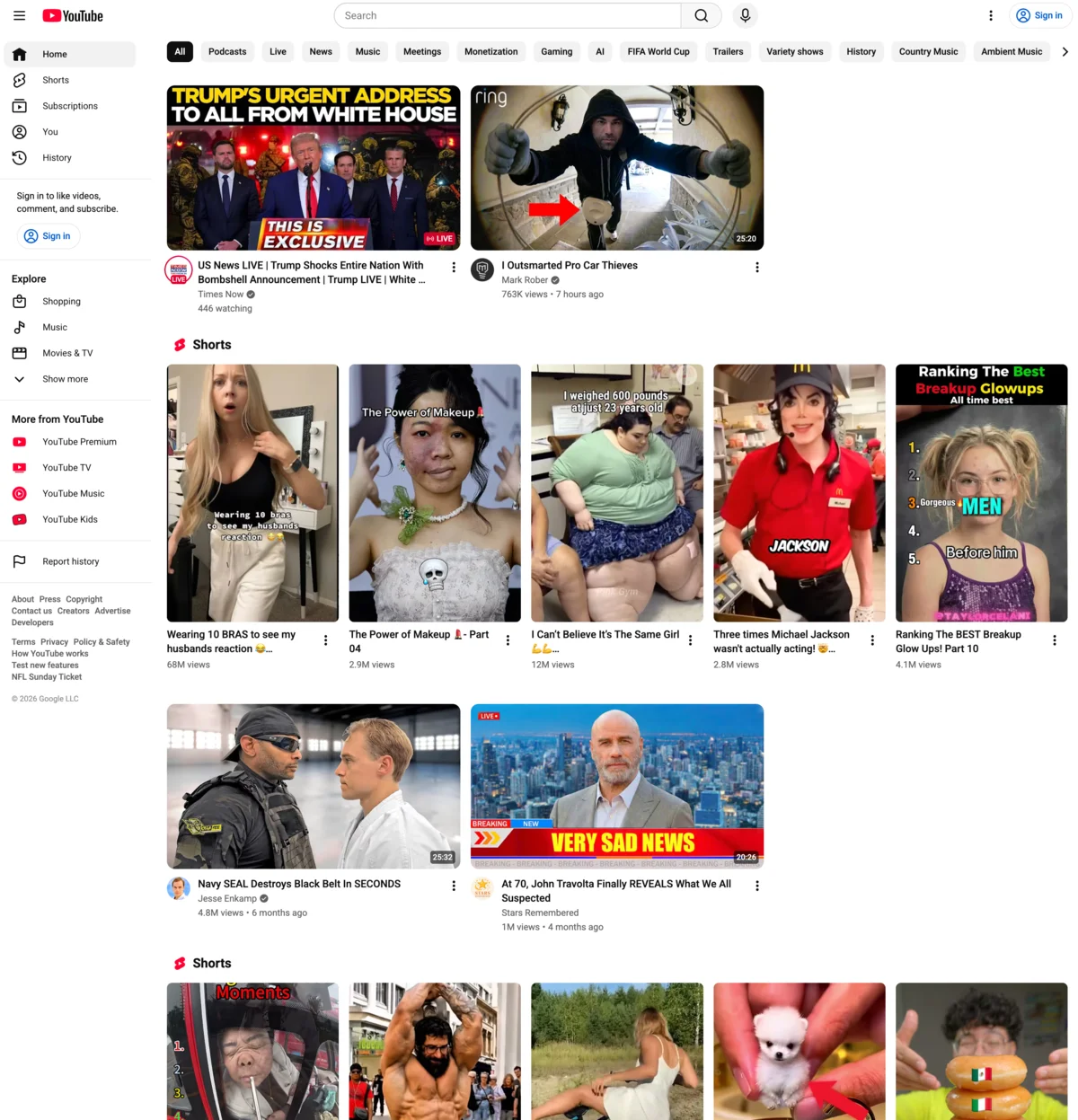
Look hard at what “the default” is, because it rattles me more than losing my own account did. This is YouTube for a blank-slate human: no history, no preferences, just the algorithm’s best guess at what a person wants. And the guess is a tour of our basest instincts: a fake “URGENT ADDRESS” news panic, staged street-fight rage bait, human bodies turned into sideshow, AI-deepfaked dead celebrities, an endless scroll tuned to the part of the brain that can’t look away.
Here’s what unsettles me as someone who builds these systems for a living: Google has more behavioral data than any institution in human history. This grid isn’t a glitch, and it isn’t my punishment. It’s their best statistical estimate of what the median person will click. If that estimate is any good, then it isn’t really a picture of me losing my account. It’s a mirror held up to all of us, and the reflection is bleak. They didn’t hand me back a stranger’s feed. They handed me back the average.
Second, and this is the part that genuinely got me: the deletion reached off of YouTube and into this very blog.
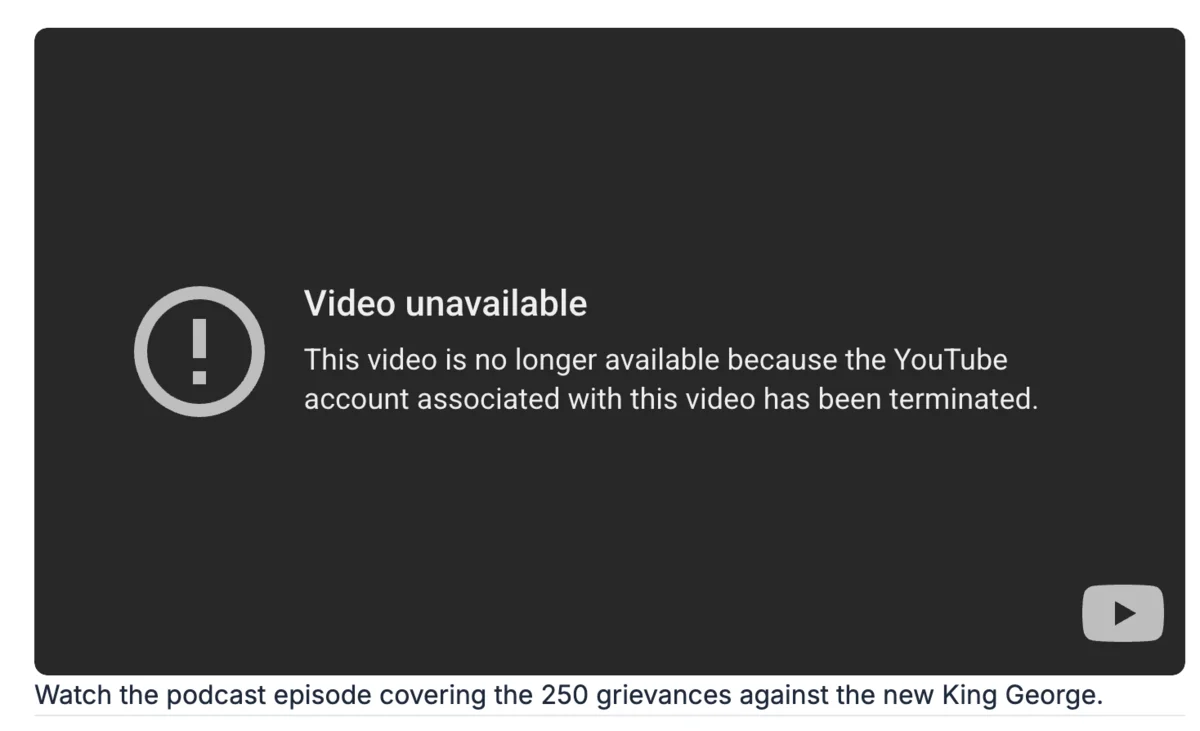
I am writing a post about YouTube deleting me, and the YouTube videos embedded in my other posts have all turned into little gray “video unavailable” boxes. The censorship has a footprint, and it’s stamped across pages I host myself.
The New Censorship Is a Confidence Score
We have a mental image of censorship as a person: a bureaucrat with a stamp, a network exec killing a segment, a guy pulling books off a shelf. That image is now wrong. The accuser, the judge, and the executioner are the same model, and the appeals court is its cousin. “Due process” has been refactored into a UI element that returns false.
I’m not naïve about scale. A platform with billions of hours of video can’t put a human on every case. But “we can’t afford human review” and “we have built an unaccountable, automated system that can erase sixteen years of a person in an afternoon and never explain why” are the same thing. One is the press release; the other is the receipt.
One last thing. The podcast YouTube decided was “spam” didn’t die with the channel. A podcast is just an RSS feed, and an RSS feed doesn’t answer to anyone’s confidence score, so I ported the whole back catalog to Apple Podcasts and Amazon Music. Turns out you can’t unperson an RSS feed!
I’ve now used my one allotted appeal. So if there’s an actual human somewhere at Google reading this: hi. Apparently you’re a rare commodity. I’d love to know which 250th-anniversary joke a robot couldn’t take 😘✌🏻!
Related Posts
A Bot Deleted My Account. Google's Fix: Delete My Family.
Weeks after YouTube erased me, I finally reached a human at Google. Their official solution to getting my music back involves deleting my family group and hand-migrating 16 years of Google Drive. Here's why that's worse than it sounds.
Save Mr. Stephen!
Sport a mustache for a month. Let's save Colbert from CBS's cowardly cancellation.
My Own 'Can't Let It Go': Trump, the Press, and Golden Lapel Pins
A perspective on John Oliver's recent segment on the White House Press Pool and golden lapel pins.